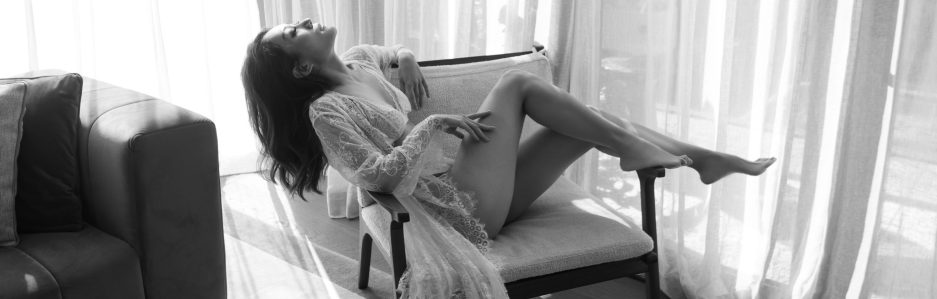
Good As New

They picked me out of a hodgepodge toy box
and placed me in a white bed of angels, white-smocked
boys and girls stood over me with pencils and erasers
as if I was a tough one to crack, as if something
was multiplying exponentially inside of me.
The nurse put me in a swollen dress someone’s aunt died in
and said tomorrow I should be good as new, oh good as new,
I wondered whom else she said it to, did she say it to
the girl on the other side of the wall who searched
for her left breast with her right hand, who searched
for her left breast with her right hand all night.

By the time they put me in a tumbrel bound for the guillotine,
I already saw the anaesthetist’s red-rimmed eyes,
the surgeon’s red-bladed scythe. Their salted breath
fell on my neck, as Marie Antoinette’s high-wigged head
sagged over the red elms. It was then that I sensed
the place the scalpel was headed, the incision cold and precise.
If I wasn’t afraid, then nothing will ever make me afraid.
The moment I awoke, a distant voice spoke, the words came
undone one stitch at a time, my beautiful rhymes broken,
my lovely years gone, oh my beautiful rhymes broken,
my lovely years gone, gone, gone.

Whatever they took from me turned, turned its color
under the sun, and I was forbidden to go under the sun.
Still, I ran out of the sterile ward at five o’clock and found nothing more
alive than myself, wearing this gauzy dress someone’s aunt died in,
standing between the mossy stones and a lost bee.
I tiptoed around this sudden hole in my belly, catching earthly
elements released from my mother’s womb, and her mother’s,
and her mother’s, and her mother’s, houses of heirlooms. If only I knew
how to return to the warmth of her womb. If only I knew
how to have her bear me again at full moon, a perfect little doll,
seamlessly patched-up, and almost, almost, almost, good as new.


Originally published in Peeking Cat Poetry Magazine, issue 9.

Seventh Piece (Love’s Paradox)

There, five inches above your rosy skin, is a hand,
a gesture, a hesitation, a tired bird looking for a nest, my hand.

How infinitely close Pluto is to his gold-haired Sun.
How infinitely far you are to my uncertain touch.

Why have we come to this, darling love!

On this cold blue evening we are as close as two stars,
and as far apart as you are in my arms.

Onion

This is not about
how she makes me cry.
It’s not even

about the tender heart, tied
to a secret, hidden
beneath her

white organza dress, unattainable
despite my teary efforts.
You see – this is about

her coming to ripeness in my garden,
a full moon rising
to the high throne. Indubitably she is

the queen’s picking, fattened virgin
bulb, green stalks
soon to flower. Overnight,

poignantly and nervously, she drags
her robe of white mist
in slow waltz, my sweet deb.

Come daybreak I will have to take her
out of her loam-perfumed
boudoir, and marry her off to the gentle

yellow bell pepper.


Originally published in Mount Hope, Issue 9, Spring 2016

The Upstairs Neighbors

The daddy must be gnawing at the bones
of the mommy who coos, coos and coos
over the crying baby who makes a boo-boo, like all nocturnal families

do, oh they do, don’t they, they do

the clunkity-clunk, the yakity-yak,
and the bibbidi-bobbidi-boo,
the happy rigadoon and a mouse at two

in the half-moon bedroom. I’m running out of
sleeping capsules, my tricolored silencio!
Red, white and bright starry blue. Saviors of America.
I mean, insomnia. No, really, I do
mean my nebulous wakefulness
at half past two.

Tell me what I should do, do, do
to stop my roof from – boom! boom! –
falling down. The woeful spinster clomps, clomps, clomps

clomps down on my papery skull. Why wouldn’t she take off
her wooden shoes? Is she masking the echoes

of the owls’ raucous hoots?

Up, up, up
into the reddening sky
I see them go.

They are all in cahoots!


Originally published on October 29th, 2015 on my old blog. 

The Island

On a warm Wednesday I went to Ellis Island alone. That morning I poked the yoke of my husband’s sunny-side-up, and burnt his toasts on purpose. On hands, on knees, on chafed discontent, I crawled all the way to Miss Liberty’s crowned head. I’ve often had dreams like this. Blue veins of oceans pumping salt-water into my wounded canoe. I shall never make it to her alive, I’ve traded my paddles for the low simmering kettle expectant of boiling so I could thaw this damn chicken for the dinner party where I shall be red-lipped, high-heeled and properly elusive. But I shall never make it to her alive, not this moment when the jungle-red sun has been hushed, and my soapy hands are clasping the soiled collar of an ill-fitted and tedious shirt with such stubbornness. I scrub it into moonrise whiteness, so white that I could almost start over in my weightless sleep. My dream takes me to the island – the stone – lipped woman married to the hands of the mason who sculpted her into perfect stillness. I touch her bare petrous toes, they are cold as my own. She is close – so close that the burning torch in her hand could almost be mine.


Originally published in Sweet Tree Review, Winter 2016. 

Sixth Piece

You see how –
one moon
orbits one earth,
against all reasons, unaware
of beginnings or endings,
witnessed by a universe
of joyous stars.

And that is how –
I have always loved you
under the constant moon
as we walked down
the long, thin, twinkling
orange grove –
I have loved your bashful smile,
against all reasons, unaware
of beginnings or endings.

The Great Pine In Our Land

Between sunrise and bedtime,
everything is believed and therefore
blessed. I come from a bleak land
where the sun never lingers
long enough for us to trust
the open arms of darkness.

Sometimes night comes so fast,
like galloping steeds bearing shadows,
that children forget hunger
and kneel down to pray

around the towering great pine
in the middle of our land where
an old man hums a tune as he
gives his faithful dog a piece of three-day-old
bread. The pigeon comes and snatches it away
from the old man’s palm before the dog
could open its mouth.

The scene repeats itself when fish is absent
from the oceans.

Repeats itself when roses are unreturned
to the gardens.

Repeats itself when the dog remains hungry,
and the pigeon fattens by flour and stolen glory.

And above the circle of our praying children,
the scene repeats itself in the obedient bones
of our fathers, in the yellowing skins of our mothers,
and in the collected debris of our patient existence.

And it won’t stop repeating itself
until the distance is undone
by the lifetime of a poor laboring snail;
until it’s sunrise when everything is believed
and therefore blessed.

The old man, sitting under the great pine
in the middle of our land, never stops
giving bread.

The Pathos of An Attic

I rarely go up there anymore.
Too many shards and tatters
jutted out, like an obtusely ill-grown tooth
scraping the membrane
of my tender memories.

Those days were young
like an unbroken promise, we sat up there
together in a great chair that could fit two,
with a book of fables that never rung true.
Our kisses went on under July’s sunlight,
against all possible endings
and the moon.
Quiet ripples of endless summer nights,
and her dress was drenched in sweet wine.
She was made of ringlets of laughters,
made of the scent of an apple orchard.
She was made of all good things
that slipped through my fingers.

I rarely go up there anymore.
Why would I?
To sit in that empty chair,
and gather pots of dirty daffodils?
To read those moth-eaten letters,
and utter sentences with no arrival?
To be scolded by that cranky old piano
desperately missing her touch?
Or to be drowned yet again in the immense silence,
still more immense without her?

All day I rummage through the other parts of the house –
the den’s nose, the kitchen’s fingertips,
the bedroom’s tear ducks.
All day I rummage through my body
for a sad corner, for a cigarette,
for a blue dream without her presence,
until the attic is as far as she is to me,
a distant nebulous star.

At nightfall, I sit upon the broken staircase,
palms dusty, sorrows over.
The wind quickens to a new horizon.
I see myself forgotten.

I love her still among those shredded things.
But I rarely go up there anymore.


Originally published in Visual Verse, Vol 02 – Chapter 12

How To Cross A Bridge

At four thirty I stand at the end of the bridge
watching my daughter descend
from the yellow school bus.

We begin our journey home
as the sun leans wearily to the west.
Her schoolbag is painted with funny daisies.
Inside there are many unanswered questions.

It takes three hundred and four steps to cross this bridge
to our white stucco house with a wooden swing.
She likes to go higher and higher, my fatherless daughter.
My own father left me on a cloudy day in the winter.

I often ask my daughter to count her own steps home,
but she rather skips and hops and says hello to the ducks.
I think about whether her eyes will grow
into a deeper blue like her father, as I often think about
these small and inconsequential matters.
Was it calla lilies that I carried
on my wedding day
or did I lay them down
on my husband’s grave?

As my daughter begins to run, her shadow
tearing away from mine, my terrified limbs
give birth to a butterfly. One hundred and twenty-one steps,
or is it one hundred and twenty-five?
God please help me go back to zero before all my sadness began.

I want to know what makes my little girl come back
to hold my hands as if they are her own gloves.
I want to remember the way she looks at me,
like how she would look at a dying deer,
with eyes like two blue stars
from the vast universe shouting to me,
mommy, mommy, don’t be afraid.


Originally published in Mouse Tales Press in September 2016.